1
Question 1 of 15
What is electricity?
This KS2 (Key Stage 2) Online Electricity Quizzes quiz contains 15 multiple choice questions designed to help you revise and test your KS2 Science Quizzes knowledge. Select an answer for each question and click “Submit Answer” to see instant feedback. Take your time and try to score as high as possible!
KS2 (key stage 2) Online Electricity Quizzes
(Fun and interesting ks2 Electricity Quizzes for children that wish to better prepare themselves as they go in for the end of year ks2 SATs or for children that wish to boost their knowledge and increase their performance in class)
Welcome to this online revision platform. In this section, we will be looking at electricity, electric current, the uses of electricity and the types of electric current.
An electric current is the rate at which electric charge flows past a point. The amount of electric charge on an object is measured in coulombs ©. There is a force that exists between two bodies because they possess a property known as charge charge and this force is called the electrostatic or simply electric force.
Types of electricity
There are two different types of current in use today and they are direct current and alternating current. Current Electricity can also be classified as direct current or alternating current based on the voltage source.
Effects and uses of Electricity
The quizzes here are to help you to improve your knowledge about KS2 electricity and all our quizzes are also free of charge. So, you can take them anytime and anywhere. With all that said, are you confident to answer all our quizzes? Try them now
Play Learn and Enjoy!
Question 1 of 15
What is electricity?
Question 2 of 15
How do we call materials that does not conduct electricity?
Question 3 of 15
Which materials allow electricity or electric current to flow through them?
Question 4 of 15
Why do we coat electric wires with insulators?
Question 5 of 15
What is the process of covering electric wires with plastics or rubber?
Question 6 of 15
Which of the following is a good electrical conductor?
Question 7 of 15
Which of the following sets are electrical conductors?
Question 8 of 15
Which of these is a source of electric power?
Question 9 of 15
A path around which electrical current flows is called ________.
Question 10 of 15
If you have a circuit with two identical bulbs and the one bulb is dim(not shining as bright) than the other, then,_____
Question 11 of 15
What happens when two identical bulbs are connected in parallel in an electric circuit?
Question 12 of 15
What is the most essential feature that all circuits should have?
Question 13 of 15
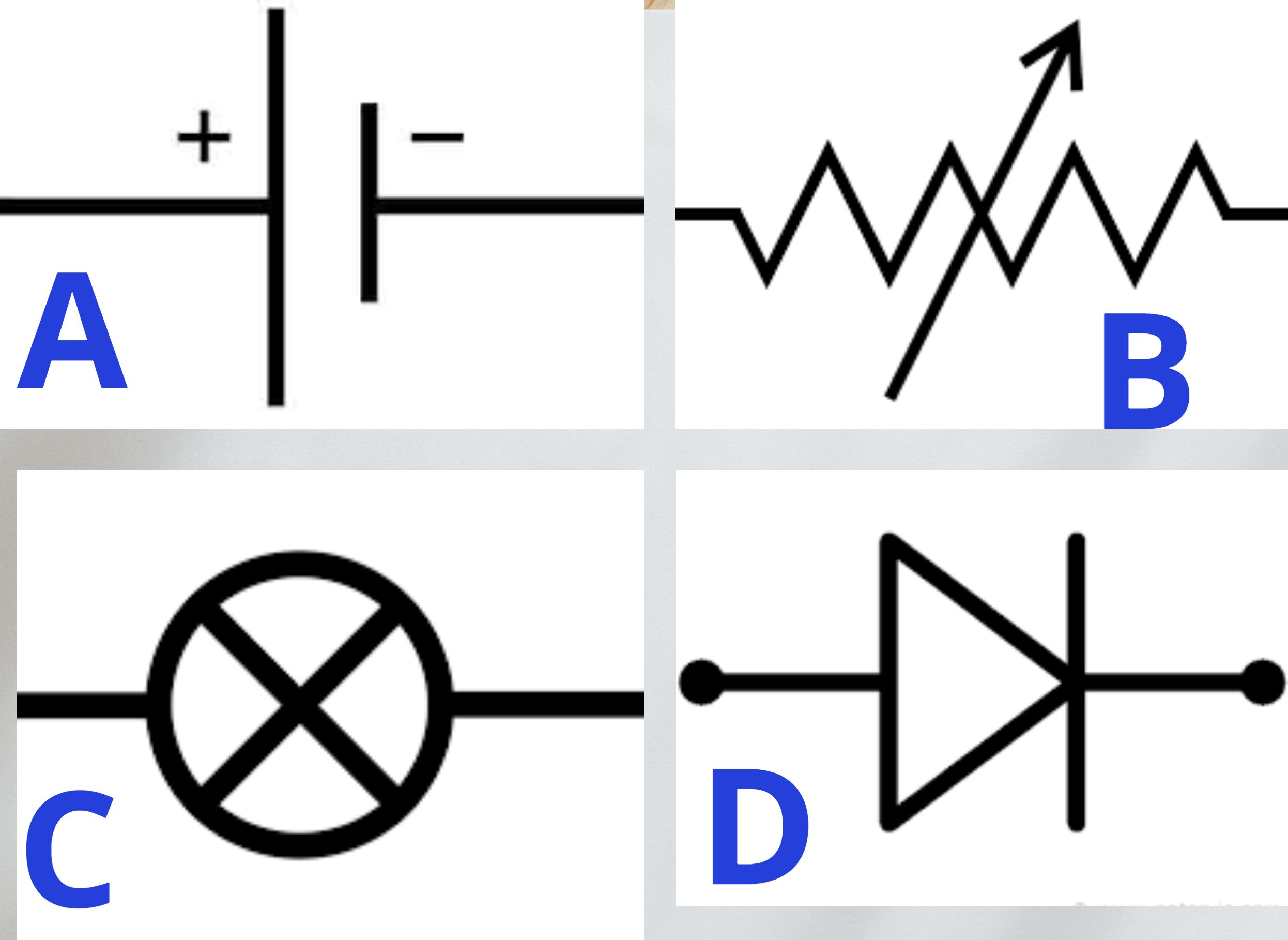
Which of the symbols below represents a bulb in a circuit?
Question 14 of 15
______ is the symbol of a battery in a circuit.
Question 15 of 15
Which of the symbols below represents a diode in and electric circuit?
KS2 (key stage 2) Online States of Matter Quiz Revising KS2 States of Matt...
KS2 (key stage 2) Online Forces Quiz Revising KS2 Forces with quizzes. (Ca...
(Fun and interesting ks2 Sound Quizzes for children that wish to better pre...
(Fascinating and Engaging KS2 revision quizzes on levers for children in ye...