1
Question 1 of 15
Scientists are always seeking information about our Solar system and beyond. Which statement is most likely to be FALSE about this situation?
This Environment earth and universe quiz quiz contains 15 multiple choice questions designed to help you revise and test your Environment earth and universe quiz knowledge. Select an answer for each question and click “Submit Answer” to see instant feedback. Take your time and try to score as high as possible!
In this quiz, you will learn a lot of fascinating things about the universe as a whole. Hope you are excited to go through quizzes concerning the universe and Earth in particular. The world has always been known to most have evolved from somewhere, and the world itself is just a small part of the Universe. Knowing that we are only a small part of a much very large existent universe.
Studies of the earth's environment will help you to know how to avoid natural disasters like earthquakes, volcanic eruptions, and landslides while the universe will help you to know how we came into existence and how future things could turn out.
An environment is simply our surroundings as a whole. The Environment Earth is divided into layers, these are :
We also have the universe which contains the Earth, all the planets as well as the galaxy, stars, the sun, and the moon as well as space.
You could live for a hundred years studying the Earth but still not know everything about the universe, so this is just a small part of the topic. Do well to take the quiz and test your knowledge, this will prepare you for any exams you have coming up.
Enjoy!!
Question 1 of 15
Scientists are always seeking information about our Solar system and beyond. Which statement is most likely to be FALSE about this situation?
Question 2 of 15
The earliest theories on falling objects suggested that the heavier the object, the faster it falls. We now know that all objects fall at the same speed if only the force of gravity is acting on the object. If the following four objects were dropped from 10 metres above the Earth's surface, at the same time,The earliest theories on falling objects suggested that the heavier the object, the faster it falls. We now know that all objects fall at the same speed if only the force of gravity is acting on the object. If the following four objects were dropped from 10 metres above the Earth's surface, and the experiment repeated on the Moon, which statement is most likely to be FALSE?
Question 3 of 15
Which is used to treat soil which is too acid?
Question 4 of 15
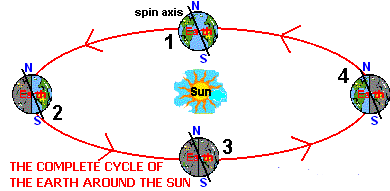
Which position in the cycle corresponds to the Autumn season in the Southern Hemisphere?
Question 5 of 15
Which description corresponds to erosion?
Question 6 of 15
A lump of basalt was weighed before and after dipping into water. The experiment was repeated with a lump of sandstone. The sandstone produced bubbles and gained significant weight. The basalt produced no bubbles and weighed about the same. What can you say from the experiment?
Question 7 of 15
Which of these rocks will erode away the slowest?
Question 8 of 15
Which statement is TRUE about fossils?
Question 9 of 15
Artificial satellites are usful objects which can be put up in space to orbit the Earth. Which statement is TRUE about the use of artificial satellites?
Question 10 of 15
Which matches the time it takes for the Earth to spin round once on its axis?
Question 11 of 15
The Sun is a __(1)__ object because it makes and gives out its own __(2)__. A __(3)__ eclipse happens when the Moon is directly between the Earth and the __(4)__. The __(5)__ blocks out light from the Sun so the __(6)__ goes dark. Which word is missing from __(4)__?
Question 12 of 15
Which of the following explains the 'Greenhouse Effect'?
Question 13 of 15
Which is a product from the complete combustion of a fossil fuel?
Question 14 of 15
The earliest theories on falling objects suggested that the heavier the object, the faster it falls. We now know that all objects fall at the same speed if only the force of gravity is acting on the object. If the following four objects were dropped from 10 metres above the Earth's surface, at the same time, which object is most likely to hit the ground 3rd?
Question 15 of 15
Which sequence most closely describes the process of forming sandstone?