1
Question 1 of 15
In pure monopoly, price is:
This A Level Economics Quiz 2019 Part 2 quiz contains 15 multiple choice questions designed to help you revise and test your A level Economics Quizzes knowledge. Select an answer for each question and click “Submit Answer” to see instant feedback. Take your time and try to score as high as possible!
Economics includes the study of labor, land and investments, of money, income and production, and of taxes and government expenditures.
Just from its definition we can automatically say that it deals with a lot of mathematics and reasoning. Bringing these calculations to an exam, it becomes a huge problem for most advanced students. In a way to help out, we have designed a quiz of 15 questions. This quiz aims principally at testing students who are preparing for the upcoming session of the CGCE Advanced level.
The questions present are questions from the June session of 2019 Advanced Level Economics. We can bear in mind that the best way to prepare for an exam is to solve its past questions. With a focus, a student will be able to go through this quiz and ace all the questions.Upon completion of this quiz, you can move on to the next session. The next quiz is the continuation of the year 2019 and it also contains 15 questions.
Question 1 of 15
In pure monopoly, price is:
Question 2 of 15
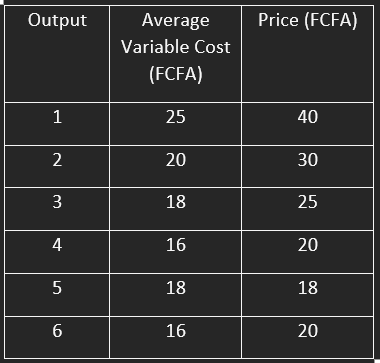
In a perfectly competitive market, what short run decision will you advise this firm to take at output 6?
Question 3 of 15
The main feature of firms in the monopolistic market is:
Question 4 of 15
If the marginal revenue is equal to zero in the monopoly market, the value of price elasticity of demand will be:
Question 5 of 15
A national industry aiming at financial autonomy will charge the price where:
Question 6 of 15
If price is less than MC, a firm in perfect competition could increase profit by:
Question 7 of 15
The minimum payment required to maintain a factor of production in the same line of production is called:
Question 8 of 15
Wages differ within the same occupation because
Question 9 of 15
This question is based on table 3 which shows the rate of interest and idle balances in a given economy in a certain year. The supply of money is 1,000
What amount of active balance will give rise to an 8% equilibrium rate of interest?
Question 10 of 15
Normal profit is:
Question 11 of 15
Double counting can be avoided by:
Question 12 of 15
The problem of using other countries’ resources when measuring national income can be solved by:
Question 13 of 15
This question is based on the statistics below:
Gross national product at market prices =2,000 million FCFA
Net property income from abroad =-20 million FCFA
Indirect taxes =160 million FCFA
Subsidies =100 million FCFA
Capital stock =8,000 million FCFA
Depreciation = 10% of capital stock.
The value of national income is:
Question 14 of 15
The real difference between real national income and money national income is that:
Question 15 of 15
The paradox of thrift assumes that:
Economics as a whole is a social science subject concerned chiefly with des...
Economics is a branch of social science that studies how individuals, house...
Economics is the study of how humans make decisions in the face of scarcity...
Economics as a social science subject is the scientific study of the owners...