1
Question 1 of 20
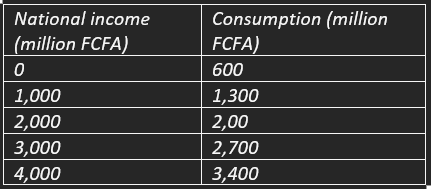
The Table 3 shows a country’s consumption at different levels of national income.
What is the savings function?
This A Level Economics Quiz 2018 Part 3 quiz contains 20 multiple choice questions designed to help you revise and test your A level Economics Quizzes knowledge. Select an answer for each question and click “Submit Answer” to see instant feedback. Take your time and try to score as high as possible!
Pual A. Samuelson defined economics as the study of how societies use scarce resources to produce valuable commodities and distribute them among different people.
Students are always puzzled when someone has a good grade. The key to having a good grade is answering past question papers, especially the most recent years. It’s simply the best way to prepare for an exam being official or not official, because you can now examine if you have a mastery of the syllabus, how questions are being asked and most importantly where you are lacking. So, in our own way to help you out with this, we have chosen a recent year, June 2018 A-level Economics paper to help test your preparedness. We have set a quiz of 20 questions, with each question having four possible answers.
Bear in mind that you’re dealing with MCQs, each answer is similar to the next. So, take your time to understand each question before proposing your answer.At the end of this quiz, we have also prepared another session of quiz which is made up of 15 questions. For more questions click more or you can also visit our website
Question 1 of 20
The Table 3 shows a country’s consumption at different levels of national income.
What is the savings function?
Question 2 of 20
In a closed economy without any government, the savings function is given by S=
-50 + 0.4Y. If the national income is 500, calculate the average propensity to consumption
Question 3 of 20
The power of issuing bank notes in Cameroon is confined to:
Question 4 of 20
The total amount of money the banking system can create with an initial deposit of
100,000 FCFA and a legal reserve ratio of 25% is:
Question 5 of 20
What relationship exists between the speculative demand for money and the
transactions demand for money?
Question 6 of 20
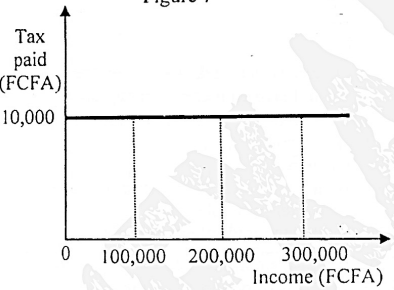
Figure 7 relates to the amount of tax paid in relation to different levels of income.
Which tax system is represented by this diagram?
Question 7 of 20
________involves deliberate actions by the government to stabilize the economy by spending on goods and services and changing the rate of taxes.
Question 8 of 20
An individual earns 200,000 FCFA and has a tax allowance of 40,000 FCFA. If he pays a tax of 20%, his average rate of tax would be:
Question 9 of 20
Which of the following is a measure of solving a balance of payments deficit in the
long run?
Question 10 of 20
The exchange rate system practiced by the countries of the franc CFA zone and the
European Union is known as:
Question 11 of 20
You are given the following data on acountry’s trade transactions. Figures are in million FCFA
Visible imports 550
Balance of trade 750
Invisibl balance 1,000
Net transactions in assets and liabilities 400.
What is the value of visible exports?
Question 12 of 20
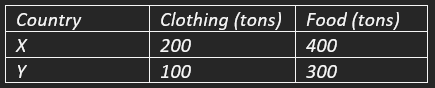
The Table shows the output per unit of input of two goods produced by two countries.
It can be concluded that:
Question 13 of 20
At what phase of the trade cycle would one expect the marginal propensity to
consume in an economy be highest?
Question 14 of 20
1. This question is based on the
following:
(i) Reducing the minimum amount necessary to open a bank account.
(ii) Allowing political instability
(iii) Increasing incomes
How can savings be mobilised for growth to take place in an economy?
Question 15 of 20
Which of the following will reduce regional unemployment?
Question 16 of 20
If government spends 900 billion FCFA and raises 900 billion FCFA from taxation. This would cause national income to:
Question 17 of 20
Which of the following will result in an increase in demand?
Question 18 of 20
Which of the following financial institutions controls the monetary policy in
Cameroon ?
Question 19 of 20
In perfect competition:
Question 20 of 20
In a regressive tax system:
Economics as a whole is a social science subject concerned chiefly with des...
Economics is a branch of social science that studies how individuals, house...
Economics is the study of how humans make decisions in the face of scarcity...
Economics as a social science subject is the scientific study of the owners...