1
Question 1 of 16
Michael loves playing balls, his favorite are blue balls. How many blue balls are there?
This KS1 Venn Diagrams Quizzes quiz contains 16 multiple choice questions designed to help you revise and test your KS1 Maths Quizzes knowledge. Select an answer for each question and click “Submit Answer” to see instant feedback. Take your time and try to score as high as possible!
Revising Venn diagrams with quizzes.
(KS1 Venn diagrams quizzes for pupils preparing for their end of term or end of year KS1 exams)
Hi there! and welcome to gcequiz.com. In this section, we will be talking about what the Venn diagram is KS1 Mathematics is all about. gcequiz.com has also put together a good number of quizzes to ease preparations for your exams. These quizzes will not only help you prepare well for your exams but they will also help to boost your performance in class.
To fully understand what the Venn diagram is all about, you need to have an idea on what SETS are. A Set is simply a collection or a grouping of well defined items, we have as an example; a set of boys, a set of houses, a set of counting numbers less than 5 and so on. Sets are subdivided into finite and infinite sets and if you wish to know more about these, click Here.
Therefore a Venn diagram is a diagrammatic representation of two or more sets (That is overlapping circles) outlining the differences between them.
What are the prerequisites to draw a set?
There should be an understanding of the union of these sets. That is, all the elements present in these sets.
Also, the intersection of these sets should be known to be able to figure out what these sets have in common..
In general, Venn diagrams help children to sort data. The data can be of any type: numbers, shapes, colors and so on. Sorting helps students to distinguish between different object types. For example, children may be given a set of colors and be asked to separate them in two groups. Equally they may be given a set of numbers and be asked to group them in even and odd numbers.
In this quiz children will get to know more about sets and Venn diagrams, the difference and relationship between them and how to identify objects in particular. Please feel free to visit and explore other quizzes here.
Select a quiz, Play, Learn and have Fun!!!
Question 1 of 16
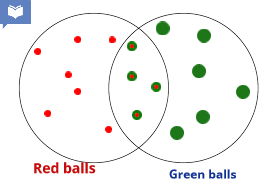
Michael loves playing balls, his favorite are blue balls. How many blue balls are there?
Question 2 of 16
How many red balls do we have in total?
Question 3 of 16
Some boys love both the red and the blue, or the blue and red balls, How many balls are red and blue?
Question 4 of 16
How many balls are there in total?
Question 5 of 16
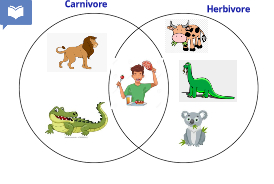
Animals are either herbivores which feed only on plants, carnivores which feed only on flesh or omnivores which feed on both. How many of these animals are herbivores?
Question 6 of 16
Which of these animals is an omnivore?
Question 7 of 16
How many animals are carnivorous?
Question 8 of 16
How many animals are carnivorous but not herbivores?
Question 9 of 16
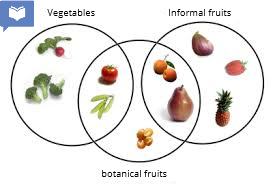
Fruits are divided into several different kinds, and informal fruits are Joe's favorite. How many informal fruits do we have?
Question 10 of 16
How many informal which are botanical fruits are there in total?
Question 11 of 16
Can a fruit be in all three sets below, that is botanical, informal and as well a vegetable, if yes, how many fruits are in all three sets?
Question 12 of 16
how many fruits are there in total?
Question 13 of 16
How many vegetables are fruits?
Question 14 of 16
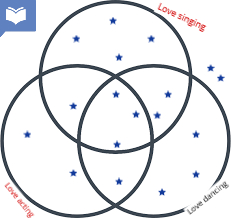
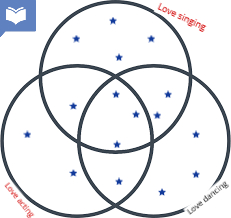
Girls in my class are expected to take part in one or two things during our graduation ceremony which is either singing, dancing or acting. How many girls took part in all 3 events?
Question 15 of 16
How many girls did both dancing and singing?
Question 16 of 16
Some students did not take part in any of the 3 events, how many of these students are there?