1
Question 1 of 20
Saving in an economy is equal to
This A Level Economics Quiz 2015 Part 3 quiz contains 20 multiple choice questions designed to help you revise and test your A level Economics Quizzes knowledge. Select an answer for each question and click “Submit Answer” to see instant feedback. Take your time and try to score as high as possible!
Economics is the study of how humans make decisions in the face of scarcity (Scarcity means that human wants for goods, services and resources exceed what is available). These can be individual decisions, family decisions, business decisions or societal decisions.
This quiz is aimed to help students get a glimpse of what the GCE multiple choice questions look like. The questions are very challenging and most of the time the choice of answer becomes a problem. We have selected 20 questions from the Advance level Economics June 2015 session for students to attempt. Each student is advised to through the questions thoroughly.
These questions are here to help you understand how you can answer particular questions and the manner of approach to these questions in the examination hall. So, make sure to go all through the question
There are other questions present which are to help you get prepared for the CGCE Advanced Level Economics. After answering these 20 questions, you move on to the next set of questions.
Good luck!!!
Question 1 of 20
Saving in an economy is equal to
Question 2 of 20
The value of the multiplier can fall because of
Question 3 of 20
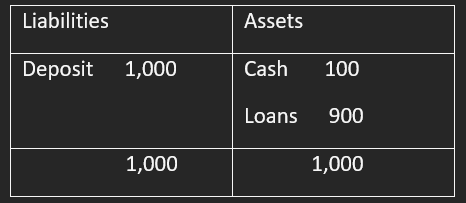
This question is based on table below
showing the T-account for a hypothetical commercial bank. The figures are in million FCFA’
What is the maximum amount of deposit this bank can make?
Question 4 of 20
In choosing a commodity to serve as money, the most important characteristics must be that it is
Question 5 of 20
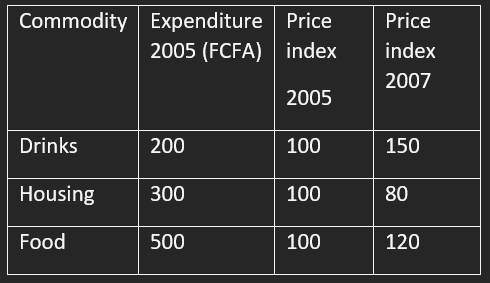
The calculation of the weighted price index shows that between 2005 and 2007, the general price level rose by
Question 6 of 20
A regressive tax can best be described as one which
Question 7 of 20
The hypothetical figures of a country’s national debt are as follows:
National debt 1,400 million FCFA
External debt 560 million FCFA
Internal debt 840 million FCFA
What percentage of the national debt constitutes a real burden?
Question 8 of 20
What expression is used to describe a situation where a new loan is contracted to pay off the existing one to reduce interest rate?
Question 9 of 20
In year I, a country’s visible imports totaled 1,000 billion FCFA and its balance of trade was 500 billion FCFA. In year 2, itsvisible imports fell in value by 4 per cent. The balance of trade in year 2 was
Question 10 of 20
Which of the following people would be pleased by a devaluation of the FCFA everything being equal?
Question 11 of 20
The adverse movement in the terms of trade means that
Question 12 of 20
Arbitrage is the process where
Question 13 of 20
The movement from any point inside to a point on the production possibilities curve is termed
Question 14 of 20
When a country increases the stock of capital per worker, increasing labour productivity, this is called
Question 15 of 20
A recession as a phase of a business cycle is characterised by
Question 16 of 20
When the real source of money, which may be from illegal sources, is hidden this is described as
Question 17 of 20
When production is carried out on the basis of the order placed by the customers, this is known as
Question 18 of 20
The systematic procedure laid down by management concerning ordering, receiving, recording, issuing and accounting for stocks is known as
Question 19 of 20
The best channel of distribution of a perishable good is:
Question 20 of 20
A machine which has a life span of 2 years yields an annual income of 121,000 FCFA. If it costs 200,000 FCFA to buy it and the current rate of interest is 10%, what is the net present value?
Economics as a whole is a social science subject concerned chiefly with des...
Economics is a branch of social science that studies how individuals, house...
Economics as a social science subject is the scientific study of the owners...
A Level Economics Quiz 2016 Part 2 Economics is often defined as the study ...